

🔥 Why Online Conversations Devolve Into Hostility
Exploring the science behind Godwin's Law
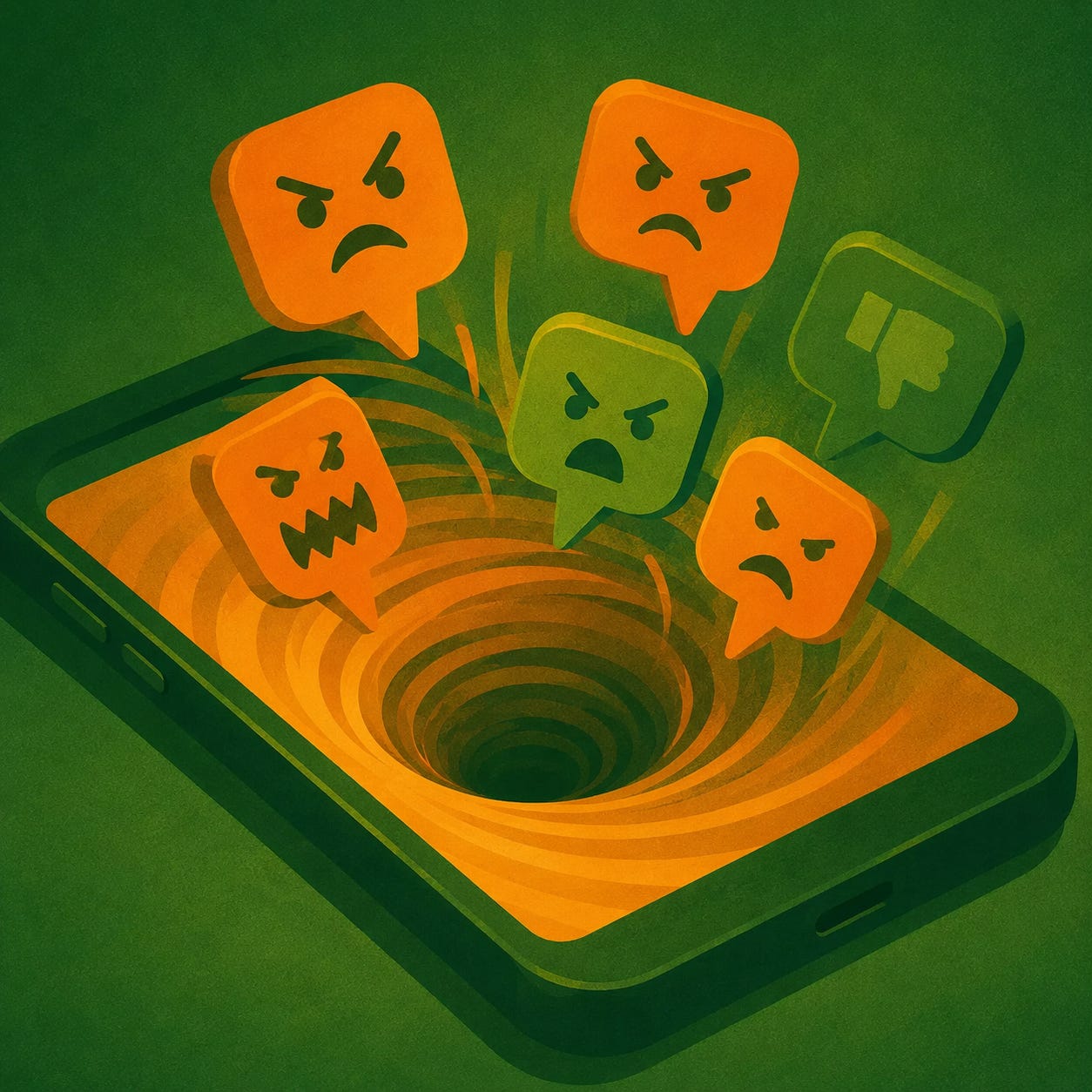
No matter how friendly an online discussion starts out, it’s only a matter of time before the tone starts to sour. Whether it’s a music forum, article comments section, or a Facebook birdwatching group (from personal experience), you will inevitably come across examples of anger, mockery, and snark.
Godwin’s law—the slightly tongue-in-cheek idea that any online discussion eventually devolves into a comparison to Nazis—has now been around for decades. Regardless of the underlying statistical truth of this specific idea, it speaks to a feeling we’re all familiar with: online interactions between humans are disproportionately nasty and chaotic when compared to traditional face-to-face interactions.
Many variables contribute to explaining this phenomenon. Online interactions are often more anonymous than face-to-face interactions, which encourages people to be less civil. The problem may also be exacerbated by the fact that people are more distant and abstracted in online communications. Speaking to someone’s face makes them feel more real and human than speaking to them through a screen, so we’re more likely to be nice in person. Social media algorithms that amplify outrage and negativity for engagement also contribute to growing toxicity online.
These are all natural explanations, and they’ve been part of the debate for a long time now. But one fascinating new study suggests we’ve been missing a more surprising and perhaps more important force at play. The drift toward online negativity may be a byproduct of the human desire to be unique and differentiate ourselves from the crowd.
🧪 What did the researchers do?
In a study published in June 2026 in PNAS, researchers sought to investigate whether online conversations naturally devolve into negativity over time. To test their hypotheses, they combined an observational analysis of real-world internet behavior with a controlled laboratory experiment.
For the observational phase of the study, the researchers analyzed over 2 billion comments across over 2,000 Reddit communities from 2008 to 2022 . They randomly sampled 115,961 specific threads that contained at least 50 comments to ensure they looked at conversations that had reached a relatively mature state.
To confirm that any rising negativity wasn’t just a reflection of society getting more cynical overall, the researchers compared the Reddit data against a time-matched sample of ~5 million news articles from hundreds of media publishers. Because news articles are standalone publications that lack a sequential comment structure, they serve as a good control group.
The researchers used automated language analysis tools to score the emotional tone of comments, and they tracked a metric called semantic uniqueness, which measured the semantic distance between a comment and the original post. The more a comment deviated from the original meaning or theme of a post, the more semantically unique it was. This allowed the researchers to examine how far a user had to stray from the central topic to make a distinct point as the thread grew longer.
Finally, to establish a causal link, the researchers ran a simulated social media experiment involving 3,685 participants divided across five generations—each generation was a successive cohort posting comments on an evolving social media feed. To test the role of semantic uniqueness, they manipulated the participants’ underlying motivations by either incentivizing them to write something completely unique or rewarding them for conforming to what others had already posted.
🔍 What did the research find?
The researchers confirmed that online conversations do indeed become significantly more negative over time. Looking at the individual Reddit threads, comments posted later in a discussion were consistently more negative than those posted at the beginning. This only amounted to a ~1% rise in negativity, but it was a highly robust and significant effect that equated to an estimated ~25,000 additional negative comments in threads from their sample.
This trend was also true at the community level. As Reddit communities aged over the years, 62% became progressively more negative over time while only 38% became more positive. Meanwhile, the control group of news articles showed no such trend, confirming that the negativity is uniquely tied to interactive social media environments where people sequentially share their thoughts.
So what was going on in these online conversations? The semantic data suggested that as a conversation unfolds online, it becomes increasingly difficult to make a unique contribution. To stand out in a crowded thread, users expressed more negative thoughts because they’re inherently more varied and distinct than positive thoughts. As Tolstoy put it, “All happy families are alike; each unhappy family is unhappy in its own way”.
Since later comments in a thread become more semantically unique, and since negative comments are more distinct than positive ones, online conversations naturally devolve into stronger negativity. When the researchers statistically controlled for semantic uniqueness, the drift toward negativity dropped by 28% and completely disappeared at the community level, suggesting that the uniqueness element is a crucial factor.
Oddly enough, this trend toward negativity was strongest when the initial dialogue was highly positive. When everyone is being pleasant, a positive comment blends into the background while a negative comment is highly counternormative and distinct. Someone who wants to present themselves and their thoughts as unique will make a bigger impact by expressing negativity within a positive thread.
Supporting the analysis of online behavior, the lab experiment showed that incentivizing participants to be unique in their comments made them mirror the Reddit data patterns, posting more negative contributions over time. Again, this was especially true when the feed started out positively. In contrast, when participants were incentivized to conform, the negativity trend vanished entirely.
Online toxic discourse isn’t always driven by malicious actors or rage-bait algorithms, even though these influences remain important. Often, our online negativity is merely a byproduct of the well-meaning human motivation to say something fresh and interesting in a crowded digital room.
⭐️ Takeaway tips
#1. Recognize your own urge to stand out online
When you scroll through a social media thread or group chat, recognize any impulse you have to respond with an emotionally negative comment. Although posting fiery thoughts is the easiest way to be unique and eye-catching, it also contributes to a growing sense of hostility and sadness online. Sometimes, it’s important to be the contrarian who is willing to speak sincerely about a divisive topic, but much of the time, negativity is an unnecessary cost that spreads hate and outrage. So always be willing to ask yourself whether your negative comment is adding real value to a conversation or if your brain is simply taking the path of least resistance.
#2. Inject deliberate positivity into mature threads
Since human conversations naturally drift toward negativity over time as a topic becomes saturated, maintaining a healthy online environment actually requires deliberate effort. If you find yourself participating in a long-running discussion that is naturally devolving into hostility, make a conscious effort to contribute thoughts that are positive, encouraging, and constructive. It may be harder to come up with something unique this way, but it’s worth the extra thought. And even if it does repeat a theme that feels obvious, it serves as a vital counterweight to emotional decay in conversations.
#3. Avoid judging communities by their most negative contributions
It’s an unfortunate fact that online discourse naturally drifts into greater negativity as it grows with age. You can truly find this kind of negativity in the most surprising spaces. I’ve come across mean-spiritedness in community themes including parenting, gardening, guitar-playing, and even baking. In other words, don’t write off entire communities based on a few long-running conversations or dominant voices. Saturated areas are mathematically prone to higher rates of toxicity simply because users are struggling to find something novel to say. Rather than leaving a community entirely, you can always ignore the negative elements while focusing on the positive elements.
“There is nothing like just indignation for fostering unreasoning hate.”
~ Christianna Brand
People get up in their feelings about their beliefs, until admitting they were mistaken has the same psychological toll as admitting they were wrong as people who believed that thing... so it is preferable to save the ego and simply discount truth.