

🏠 Is Working From Home Bad for Your Mental Health?
New research shows how a structural shift to remote work has increased isolation and mental distress
The growing availability of remote work has offered people more flexibility and freedom in choosing how, when, and where to work. The advantages are obvious, but these kinds of blessings can also come with significant costs hiding beneath the surface.
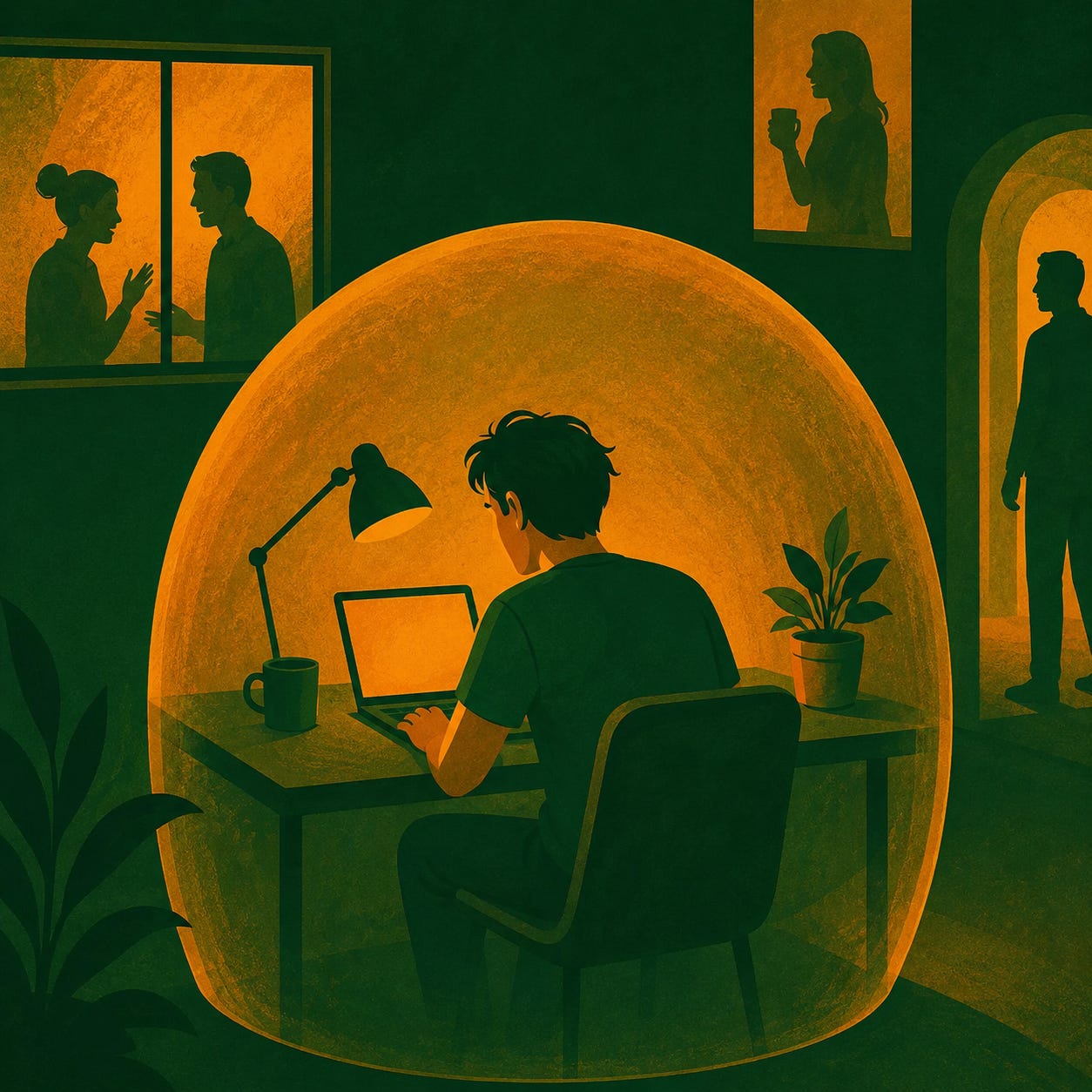
For many people, the structural absence of an office environment means far fewer opportunities to interact with people. For those living with families, this shift may not be quite so extreme. But for those who live alone, the absence of a social, in-person office environment may mean they go entire days without seeing another human being.
This is a real challenge for human health because our bodies and brains have evolved to interact with real people in front of us. We appreciate the richness of physical in-person communication—the subtle smiles, expressive body language, and absorbing eye contact. These signals are much less prominent and impactful in the more disconnected world of video calls. I’ve spent many hour-long video calls with the other person not glancing toward the camera a single time because they’re focused on a second screen or secondary task.
A new study has looked into how remote work may be impacting our mental well-being. It examines how trading the office for the home affects the hours we spend in solitude, and how those cumulative hours impact our psychological outcomes. The findings provide a data-based perspective on the real-life risks of letting our professional routines interrupt opportunities for vibrant, face-to-face social contact.
🧪 What did the researchers do?
In a 2026 study published in Science, researchers investigated the long-term mental health trajectories of American workers across more than a decade. The analysis drew on five nationally representative surveys of Americans spanning from 2011 to 2024 with a sample size of 588,322 workers. To capture the true structural impact of remote work, the researchers explicitly omitted the unusually chaotic, peak pandemic years of 2020 and 2021.
Using a standardized metric called the Dingel-Neiman index, the researchers categorized professions based on how remotable they are: highly remotable jobs such as software engineering or marketing are easily done from home while jobs requiring physical presence such as nursing or mechanical engineering are considered less remotable.
By comparing how these distinct groups changed between the pre-pandemic era (2011–2019) and the post-pandemic era (2022–2024), the researchers could look for relationships between skyrocketing remote work rates and changes in well-being.
To quantify the toll on well-being, the researchers tracked logs from national surveys and clinical measures for psychological distress such as the Kessler K-6 scale that includes feelings such as worthlessness, hopelessness, restlessness, and sadness.
🔍 What did the research find?
The researchers first looked for confirmation of changing daily schedules before vs after the pandemic. The data showed that after the pandemic, workers in remotable jobs saw a 17.9 percentage point surge in fully remote work compared to their on-site peers. This structural shift remodeled their days: compared to non-remotable workers, remotable workers spent roughly 1.2 additional hours working entirely alone every single workday. 84% of remote workers spent their entire workday completely alone, compared to just 23.2% of on-site workers.
But how did this ballooning solitude affect real mental health? The researchers found a uniform shift toward worse psychological outcomes. Relative to on-site employees, workers in remotable roles suffered significantly worse outcomes on psychological distress scales. Based on statistical models, switching from fully on-site to fully remote work increased a person’s distress score by 1.55 units. For context, someone with a score above 13 on the Kessler K-6 scale is considered to be experiencing severe mental illness.
Crucially, the rise in isolation was heavily concentrated among individuals living alone. For these single-occupant households, remote work caused an 83% relative increase in the likelihood of spending an entire 24-hour day with no real human contact whatsoever—not even passing greetings from neighbors or polite interactions with coffee shop employees.
The psychological toll was more than just vague loneliness; it manifested in concrete clinical trends before vs after the pandemic. Compared to non-remotable workers, workers in remotable jobs were 4.6 percentage points more likely to visit a mental health care professional and 1.8 percentage points more likely to receive antidepressant or anti-anxiety prescriptions. In contrast, visits for physical exams and non-mental health prescriptions (e.g. statins) did not increase at all, suggesting this wasn’t merely a byproduct of remote workers having more daytime flexibility to visit doctors.
Mental distress has seen a general uptick across the board over the last decade thanks to stressors ranging from a global pandemic to a cost-of-living crisis. The researchers estimated that the expansion of remote work accounts for roughly a third of the total rise in distress among Americans.
Many people (including myself) heavily prize the flexibility of working from home—it provides more career opportunities and more control over how our day should be organized. But it’s also easy to underestimate the slow-moving, compounding psychological costs of the solitude that comes with it. Behind the scenes, that growing solitude has become a silent tax on our well-being.
⭐️ Takeaway tips
#1. Audit your total hours of solitude
The psychological consequences of isolated remote work accumulate slowly over months and years, so it can be difficult to notice shifts in mental health. Check in with how your typical day currently looks. What time do you open your laptop to start the day and close your laptop to end the day? How much do you interact with real people during the day? How many days do you spend alone with no in-person human contact at all? Even minor social interactions like ordering a coffee in person or working from a local library can meaningfully refresh our social senses. Video calls are better than nothing, but they are not a replacement for genuine human connection.
#2. Build an intentional social infrastructure
When you work in an office, a baseline level of socialization is built into your day automatically through collaborative tasks and casual encounters. When you work alone from home, that baseline drops to zero, so you need to be more intentional about ensuring your day features real moments of social connection. Take the task of crafting those moments into your day just as seriously as you take the task of scheduling your more traditional work meetings. Recurring, non-negotiable social interactions outside the house on weekdays should be an important part of your calendar. Very often, toward the end of a work day, I’ll notice I’m feeling a little low or pessimistic before realizing I’ve spent the entire day alone. Going out for a walk, saying hello to neighbors, and enjoying moments of small talk in a coffee shop help to bring me very quickly back to life.
#3. Consider hybrid rather than fully remote structures if you live alone
The intersection of working alone and living alone creates a compounding pressure for mental distress. If you do not have family or housemates to provide ambient daily connection, fully remote work can become unsustainable for your mental health in the long term. If you have an office relatively nearby, consider working from there a couple of times a week. If not, maybe there are co-working spaces you can join instead. Occasionally sharing a physical workspace with other people removes much of the psychological burden of isolated remote work. Of course, everybody is different and some people may thrive working entirely alone. But for most people, genuine social contact is essential for mental well-being, and the data suggests we do not get enough of it when working alone at home.
“Your absence has gone through me
Like thread through a needle.
Everything I do is stitched with its color.”
~ Separation (A poem by W. S. Mervin)
This is a great expo of the research and resonates so much with our work. I think it helps so much when the sciencd backs what you know intutively and puts words to it all.