

🫀 How Do You Know Your Body Belongs to You?
New research reveals how stroke can distort limb ownership—and how the brain infers what belongs to “me”
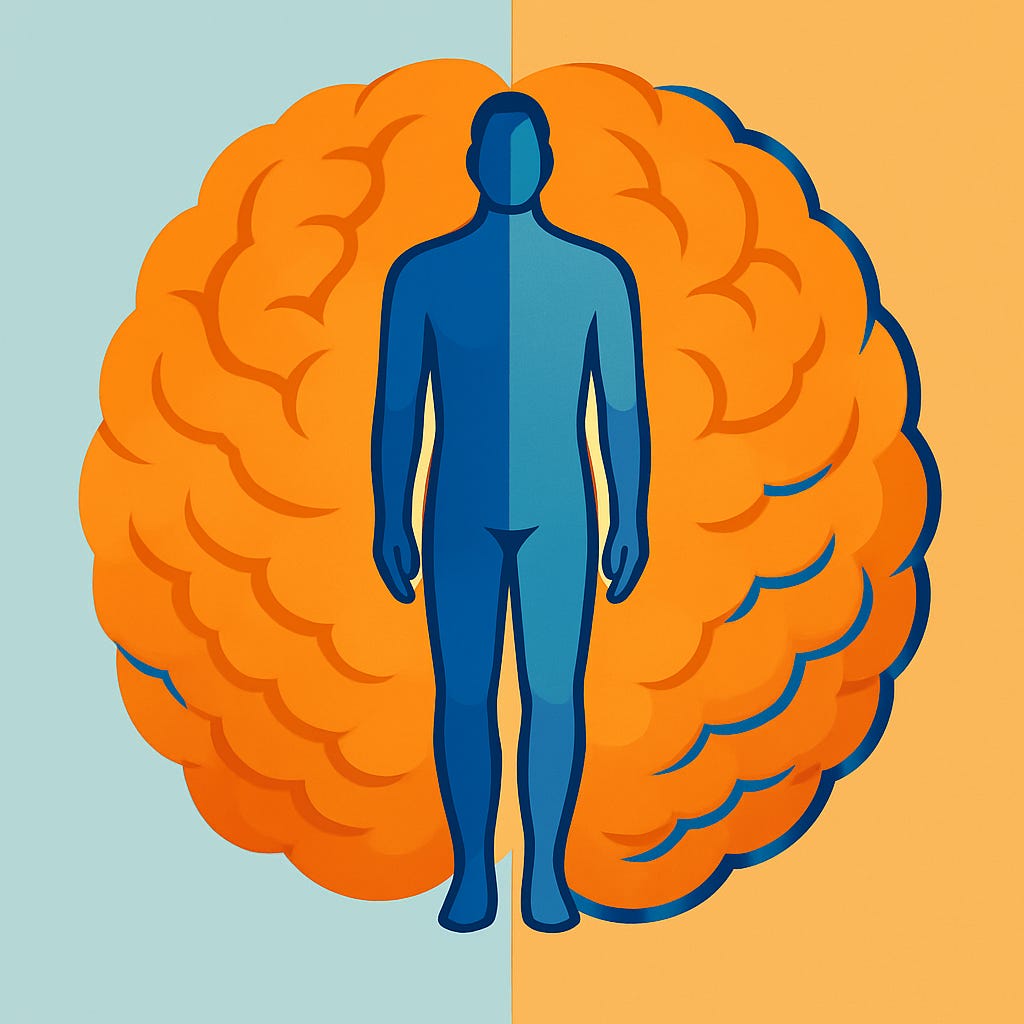
We take certain things in life for granted, including the idea that our limbs belong to us. Under normal circumstances, we don’t question or worry about whether our hand is really our hand because we experience it automatically with no apparent effort at all. It’s only when these basic human functions go wrong that we realize how hard our brain is actively working to construct a coherent sense of reality for us.
In extreme cases, body ownership problems show up as dramatic delusions. For example, somatoparaphrenia is a disorder in which patients with brain damage reject the idea that their own limb belongs to them. When challenged, they will simply confabulate that the limb belongs to someone else such as a family member.
However, these rare cases are not the full story. Mild, unnoticed distortions of body ownership may affect a far higher number of us, affecting how we plan our actions and control our attention. One recent study offers a detailed account of how body ownership is impacted by stroke. When a stroke disrupts motor areas of the brain, patients often develop difficulties with moving certain limbs. But beneath these obvious motor challenges lies something even stranger related to their sense of body ownership.
🧪 What did the researchers do?
In a study published in 2025, researchers recruited 20 stroke patients with upper-limb problems on one side of their body along with 35 healthy, age-matched controls. Each participant completed a virtual-reality task in which they had to reach their hand toward a number of targets.
During each reaching movement, the researchers manipulated the alignment between the person’s real, unseen hand (which participants could feel via their sense of proprioception), and a visible virtual hand (which participants could see via their sense of virtual vision).
On each trial of the experiment, the amount of alignment between these two senses varied, ranging from perfect alignment to large angular offsets (e.g. ±40°). A large offset meant the virtual hand was moving in a very different direction to where participants were moving their real hands. After each reach, participants rated how strongly they felt the virtual hand was their own.
This approach allowed the researchers to measure two linked indicators of body ownership:
Subjective ownership → how much the virtual hand felt like their hand
Behavioral ownership → how much the virtual hand influenced their actual reaching movements
Healthy participants typically feel ownership over the virtual hand when it’s well-aligned with how their real hand is moving. As the discrepancy grows, the illusion starts to collapse. The study investigated whether stroke patients would show a similar pattern, but some unusual effects emerged.
🔍 What did the research find?
Compared to healthy controls, stroke patients showed:
Larger ownership windows — patients accepted the virtual hand as their own even with high misalignments because their sense of ownership over their real hand was less robust.
Larger reaching biases — their motor plans relied heavily on the virtual hand’s visual position even when it was highly misleading.
In other words, both their subjective and behavioral body ownership was more susceptible to being disrupted by incongruent information around them. And those patients who were most misled by misaligned visual inputs also showed the lowest sense of ownership for their affected limb under normal conditions.
Importantly, patients only showed these unusual body ownership qualities for the specific limb that was impacted by their stroke, not their unaffected limb. They didn’t have any general deficit in perceiving the world around them, but rather damaged specific neural circuits representing one particular body part. When our brain’s natural body perception processes are disrupted, the boundary between what we define as self vs non-self becomes blurry. We feel less ownership over our own limb and we’re more likely to mistakenly adopt external agents as part of us.
How exactly was this happening? The researchers identified two key reasons.
First, stroke patients showed significantly reduced proprioceptive precision for their affected limb compared to their unaffected limb. Since they were less able to detect exactly where their limb was in space, they were more likely to be thrown off by errant visual feedback.
But proprioception wasn’t the whole story. After analyzing patients’ brain lesion patterns and structural disconnections, the researchers also linked body ownership problems with specific damage in frontoparietal brain networks. These brain areas are typically responsible for integrating different types of sensory information (e.g. vision and proprioception) as we build coherent and unified representations of our bodies and the world around us.
Just think of the simplest tasks you complete on a daily basis and consider how much brain power goes into making them run smoothly. For example, picking up a cup might seem like the simplest thing in the world, but we need to integrate dynamic proprioceptive feedback about our limb positioning, tactile feedback about how our fingers are making contact with the cup, and visual feedback about how our limbs are moving in space relative to the cup. If all of this information is integrated properly, we effortlessly pick up the cup. But if the smallest thing goes wrong, we knock the cup over and struggle to feel in control.
It’s something to better appreciate next time you take a sip of coffee.
⭐️ Takeaway tips
#1. Remember that your sense of self is built moment-to-moment
You might feel like a single, unified self, but your brain is constantly stitching together signals from your senses to actively maintain a feeling of being you. That process is usually invisible, but this study shows how delicate and dynamic it really is. When you feel a little disconnected, clumsy, foggy, or not fully grounded in your body, it’s possible your brain isn’t processing and integrating sensory information as efficiently as it normally does. Treat those moments with curiosity, and give your body more of the appreciation it deserves each day.
#2. Be more aware of your brain-body connections
Allow yourself to slow down occasionally during your day and pay closer attention to the details of how you feel in your own skin. Slow stretching and mindful walking can give you a great sense of how sharp your proprioceptive skills really are. If you fancy trying a little experiment, you can even play with your sense of body ownership with something called the rubber hand illusion (watch this short video—you’ll need a friend to help you make it work).
#3. When life feels chaotic, anchor yourself through your senses
Multisensory integration—the brain’s ability to combine different senses into a single, coherent experience—is something we take for granted every day. My favorite activity for tuning into it consciously is to mindfully eat an orange or tangerine. It’s bizarre how much a simple activity like this can be transformed by just paying attention to all the sensations involved: the tactile feeling of peeling the orange, its citrusy smell, the sweet taste, the sound of biting through the juice vesicles in each segment. Each of these small sensory anchors helps you focus your attention and let go of your overactive thinking for just a few moments.
“We must no more ask whether the soul and body are one than ask whether the wax and the figure impressed on it are one.”
~ Aristotle