

☣️ People Are Not Terrible
The strange science behind our moral calculations of individual people vs groups of individuals
Most of us carry a quiet moral confidence about who we are. We like to think we’re the kind of person who does the right thing when it matters: we’re considerate of other people’s desires, we support fairness and justice, and we help the frail old lady cross the street.
For decades, psychologists have documented something called the “better-than-average effect”—this refers to our general tendency to believe that we’re smarter, cooler, and more beautiful than the average person. This applies just as much to our moral judgments. We believe that we are morally superior to other people, and we tend to interpret our own moral errors as anomalies while interpreting other people’s moral errors as a sign that they’re bad people.
This bias in our moral judgments may in fact get more subtle and interesting as you gaze deeper into it. When I was recently having coffee with a friend, they said something that I’ve been thinking about ever since:
“You know, I feel so cynical about people in general even though I love the individual people I meet on a daily basis”
This actually confused me at the time, but the more I thought about it, the more it seemed to resonate. So you can imagine my excitement when a new research paper was released just this month testing exactly this intuition.
🧪 What did the researchers do?
In a new set of studies published in 2026, researchers investigated people’s moral intuitions by asking them to compare themselves to others—both individual others and collective others.
For a range of moral scenarios, they asked people to estimate how often they themselves would act morally, how often other people would act morally, or what the threshold of moral behavior should be to determine whether someone was a good or bad person. Let’s take the example of recycling:
Self question: In the last year, what percentage of your recyclables did you recycle?
Other question: In the last year, what percentage of their recyclables did other participants in the study recycle?
Threshold question: What percentage of recycling would distinguish between a morally good vs bad person?
Depending on the study, researchers included different kinds of “others”. Participants could rate a randomly selected individual from the study, other people in the study on average, or people across society in general. This meant the same person was judging the morality of an unknown individual and also various collectives that individual could belong to.
By comparing how people morally judged individuals vs groups, the researchers could look for interesting biases in our social perceptions and try to determine where those biases come from.
🔍 What did the research find?
A clear pattern emerged in how people judged morality across social categories. They viewed themselves as the most moral, random individuals as slightly less moral, and random collectives as the least moral.
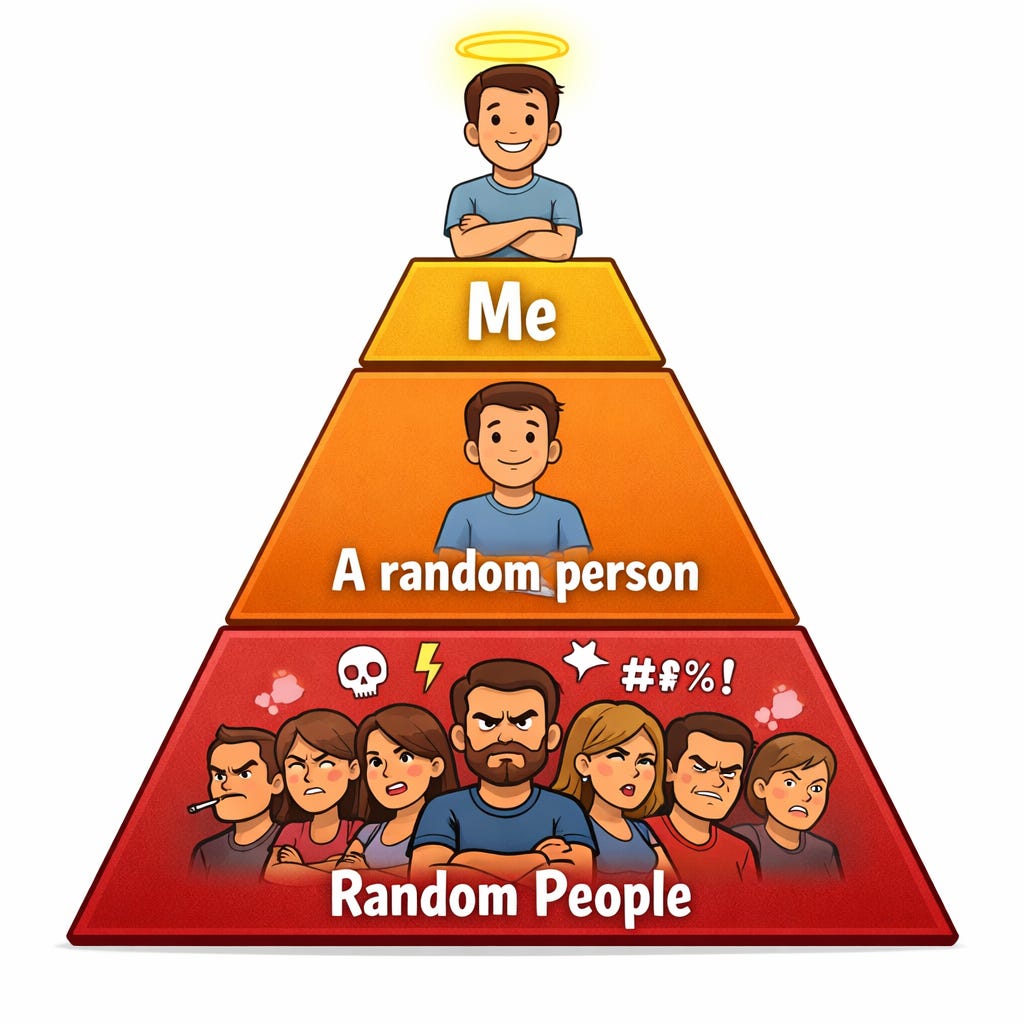
Participants consistently placed themselves above the moral threshold they defined as separating the morally good from the morally bad. In other words, they didn’t just see themselves as better than average; they saw themselves as moral in an absolute sense, performing bad behaviors rarely enough to comfortably count as morally good.
Social judgments were even more interesting. When participants evaluated other people as a collective—“others in the study” or “people in society”—they tended to place those targets below the moral threshold. That is, “people in general” were seen as falling short of the minimum standard for being morally good.
When participants evaluated a single individual—even one they knew nothing about—they tended to place that individual above the moral threshold. This was true even when the individual was completely anonymous (known only by an ID code).
In other words, people can believe “random people are bad” while also believing at the same time that “a random person is good.”
It could be that participants are simply more uncertain about a group of many individuals, and that uncertainty makes people pessimistic. But participants were actually more confident in their judgments about the collective than about the randomly selected individual. They were more convinced that the group would be morally bad on average than they were that the individual would be morally good.
Instead, the explanation seems to be more emotional according to the research. Being cynical about an individual feels like you’re risking unfairness toward a specific person, and that possibility makes people feel guilty. Since people anticipate feeling worse when making cynical judgments about an individual, they shy away from it. But they end up in a bizarre situation in which they would rate ten individual people as morally good while rating the group of ten morally bad.
The overall picture is both fascinating and a little unsettling. Our perceptions of the communities and societies around us influence how we feel and how we behave. When we feel cynical about those groups, we’re less likely to assume the best intentions from them and more likely to perceive that the world is moving in a dark and negative direction. This is generally a bad recipe for social happiness and peace.
Thankfully, our saving grace may be that we’re less pessimistic and more amiable when we interact with the individual parts of that group, which is the typical way we come across people in daily life. If we can learn to scale up our perception of the average individual to the average group, we may be able to cultivate a stronger sense of optimism and social trust.
⭐️ Takeaway tips
#1. Maybe people aren’t terrible
When you catch yourself drawing broad moral conclusions about “people these days,” notice what happens if you force yourself to translate that belief into an individual prediction: “How would I expect a randomly selected person in that group to behave?”. Since our cynicism intensifies when we shift from seeing people-as-persons to people-as-a-collective, the antidote may be to maintain a view of the individual whenever we think about the role of the group.
#2. Separate statistics from stories
Anonymity and social influence can indeed make groups behave badly at times, but this is hardly the norm when people get together in our communities. Groups may often appear immoral because vivid negative examples in the news of riots, rivalries, and wars come to mind easily. It’s the same reason we feel that getting on a plane is scarier than getting in a car, despite the statistics suggesting that entirely the reverse should be true. Before drawing conclusions about people in general, ask yourself: Am I reacting to memorable anecdotes or realistic probabilities? Distinguishing stories from statistics can prevent you from condemning collectives based on rare dramatic events.
#3. Feelings of guilt should apply to group judgments too
Feeling reluctant to judge an individual person you just met harshly is a healthy moral instinct and we would hope that other people are just as generous toward us. The feeling of guilt we would feel if we mistakenly assumed an acquaintance was morally depraved should apply just as well to mistakenly assuming a specific group is depraved. If we can assume the guy behind us in the coffee shop is a good person, we can just as well assume the people in the coffee shop are good on average too. And if the people in the coffee shop are good on average, we can assume the people in our town are good on average. And so on.
“Humankind has become so much one family that we cannot ensure our own prosperity except by ensuring that of everyone else. If you wish to be happy yourself, you must resign yourself to seeing others also happy.”
~ Bertrand Russell
I keep thinking about the idea of the “better-than-average effect” at team meetings. You know, the one where everyone’s nodding, convinced they’re the only ones with great ideas while the rest of us are just trying to keep our lunch from staging a coup. Makes you wonder if we’re really just one moral high horse away from a group therapy session.